Monday, January 21, 2013

A Week In The Life

Summer is in full swing here in the southern hemisphere.  We arrived back from Argentina to find the sun blazing down on Cerro Castillo and clouds banished from the blue, blue sky.  We also found that Chile is still as unpredictable as ever.  Mary and Cristian were in Coyhaique and we were busy unpacking our gear when a truck pulled into the driveway.  This wasn't unusual, as people drop by to socialize or sell things or pick up horses every day of the week.  This time, however, the woman who got out had a puppy in her hands.  The little ball of fur couldn't have been more than five or six weeks old, teeth barely coming in and eyes still tinged blue.  Luckily I had Mary on the phone and she was able to translate that the little guy was indeed for them, and had been promised to them some while ago from the next litter.  With that cleared up, the woman handed me the puppy, got back in the truck, and left.
 Despite all my fears and full-on maternal mode, the puppy survived his first night snuggled up to a hot water bottle and has been thriving ever since.  We've named him Hayduke (Carl just finished reading "The Monkey Wrench Gang"), he's a full blooded Border Collie, and he's a big fan of following around the other dogs and wrestling with the kittens (who are now full on cats).  I may be sneaking him home in my suitcase.

With the temperatures creeping into the 90s we went in search of a place to cool off.  In the hills behind town there are a whole series of lakes, some small and ringed with reeds, others large and more rocky.  We followed the wooden signs towards Lago Tamango down a twisting dirt road past neat little farms tucked into the hills and sudden vistas of the mountain range.  It took us about 45 minutes to reach the lake, and another five for Mary to talk the owner of some cabins into letting us access the water on her property.  It was a world class spot with the whole Cerro Castillo range visible on the other side of the crystal clear water, and the swimming was phenomenal.  The horse flies can't get you when you're under water.
 Yesterday we planned to ride horses over to Mary and Cristian's farm down the road and help haul in all the hay that was baled the day before.  We got five minutes down the road and decided that it was just too dang hot for any of that silliness.  Instead, we watered down the horses and headed to the rodeo over in Ibanez.  It was so hot that all the ice cream in the ice cream truck was melting, and people were sitting underneath the bleachers to get out of the sun.  This was the traditional type of rodeo with bronco riders and live musicians singing of their exploits.  There were gauchos from Chile, Argentina, and even an incredibly tall gentleman from Brazil.  We watched the horses rear and buck, bodies hitting the dirt or clinging desperately, while eating sopapillas with chopped tomatoes and sipping fresh melon juice.  It's a fantastic way to spend a Sunday.

Saturday, January 12, 2013

Bumps in the Road, Part II

Jackpot!
Although Chile Chico and Los Antiguos are only about 5 km apart, you can definitely tell they're in different countries.  Chilean cities are usually built around a central plaza, while Argentine cities tend to sprawl out in random directions.  Argentina has nicer cars, Audis and VWs instead of the rowdy Mazda trucks and 4WD vans favored by the Chileans.  And there are also ATMS which accept Visa cards, meaning we could finally continue our trip fully funded.

From Los Antiguos we were able to catch a bus the same day towards Puerto Deseado on the Atlantic coast.  It was a large double decker bus with seats that reclined and TV screens that didn't work - pretty much the lap of luxury as far as we were concerned.  The comfortable ride made up for the dreary scenery.  Central Argentina is kind of like Wyoming or North Dakota, and not the pretty parts.  The wide open flatlands of scrubby brush were dotted with oil derricks, utilitarian little concrete towns, and  the occasional herd of sheep.  Everything would have been fine, except that we misunderstood which stop we were supposed to get off at and ended up an hour and a half farther than needed, missing our bus in the process.  After a night short of sleep in an overpriced hotel, we reached our destination the next day around noon.

Puerto Deseado was first visited by Magellan in 1520, and also featured in Charles Darwin's explorations.  Since then, it's become a typical sprawling town with a defunct train station and a church that also served as a light house.  Finding a suitable place to sleep was somewhat challenging and involved a two mile trek out of town to a reasonably sheltered campground, which is key in a place with incessant winds.  The reason we'd come all this way to a seemingly bereft spot was what lay beyond the shore.  25 km to the south was Reserva Provincial Isla Pinguinos which, true to its name, was home to about 30,000 nests of penguins.  Real, live, penguins.  How could we resist that?

The guest list of our expedition covered four continents: two Argentine guides, two Australians, a South African, three Brazilians, and us.  We headed out around 11:30 in a bright yellow Zodiac, with the sun glinting off the brilliantly clear blue water and the wind surprisingly calm.  Not even five minutes out of port we spotted a pair of Commerson's dolphins speeding through the waves towards us.  They swam circles around the small boat, their white sides glowing through the water, before continuing on to something more exciting.
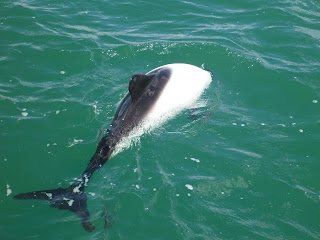
Commerson's Dolphin
We were already incredibly excited when I sighted another two fins slicing through the water.  The skipper quickly turned the boat around to see two Peale's Dolphins, larger and grayer than their cousins, coming up fast.  Within minutes they were joined by another two or three Commerson's, and we were beside ourselves watching them zip under the bow and surface right alongside us.  I was so excited that I couldn't even handle taking pictures, grinning from ear to ear and absolutely giddy with childlike glee.
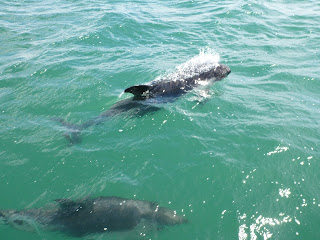
Peale's Dolphins
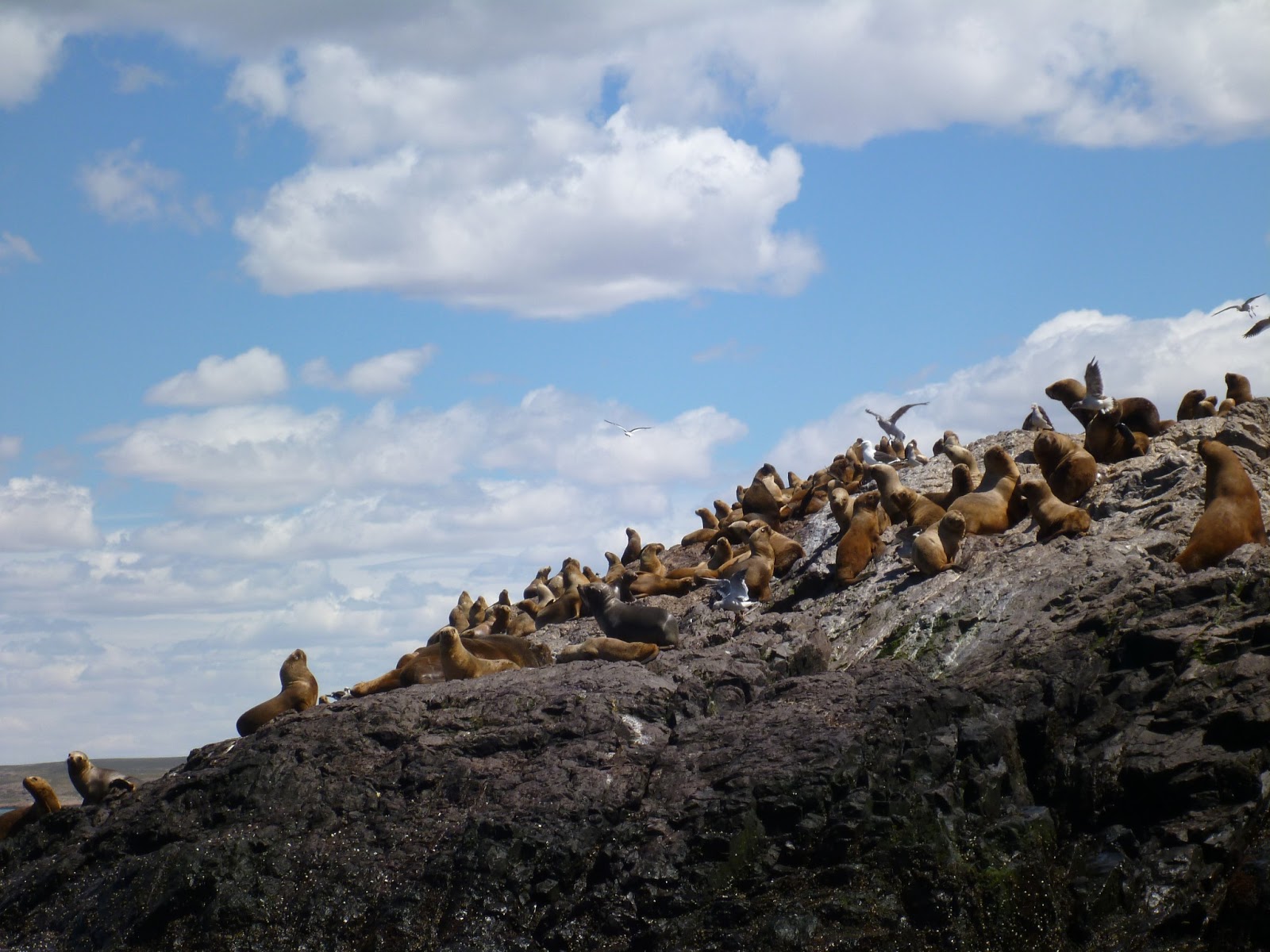
I don't even know how long we spent with the dolphins - fifteen, twenty minutes?  Whenever they moved on, so did we, heading towards some small rocky islands to experience the local sea lion population.  They sound like an old man getting out of bed, growling and grumping and harrumphing, and they smell like a fish sauce factory.  There were several harems of females with large alpha males to guard each one, and there was even a newly born pup, the same dark color as the rocks.
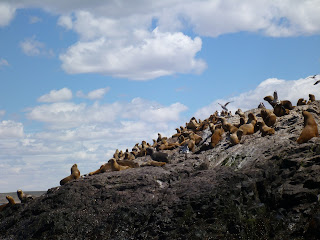
Sea lion rookery
Next stop was Isla Pinguinos, where we were greeted with the smell of rotting fish and decomposing bodies. But I don't think anyone noticed because we were surrounded by Magellanic penguins, chicks and adults, lying, standing, and waddling around.  These were the penguins I had seen at the zoo growing up, right there in front of me going about their business.  It was completely wild and totally exhilarating.
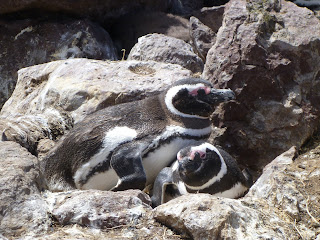
Magellanic penguins
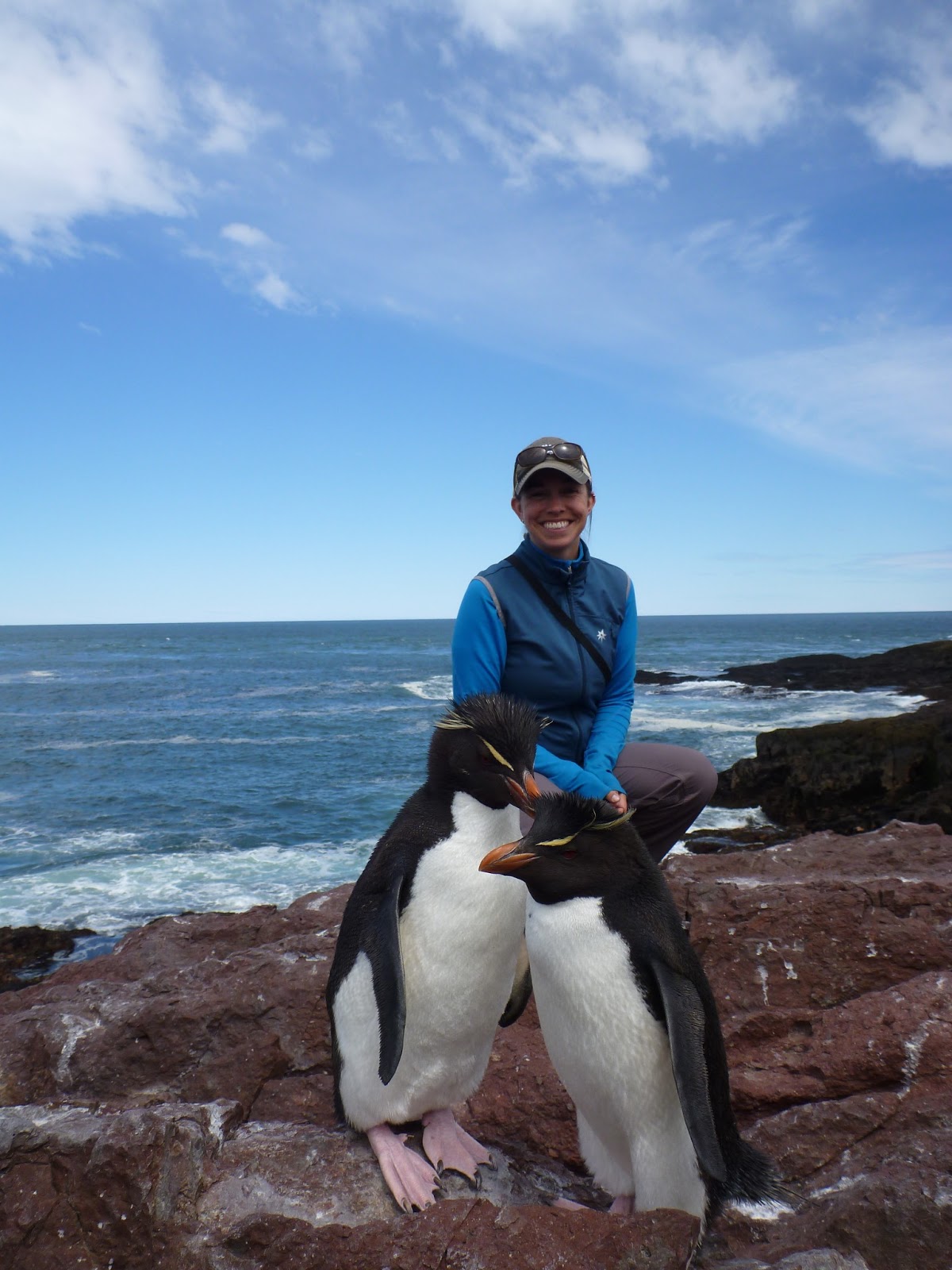
Our guides laid out lunch before we hiked over the island to the colony of rock hopper penguins.  This is the northern most population and also the most accessible.  True to their name, they do indeed hop from rock to rock up the rugged shore to reach their nests and chicks.  We got to hang out for over an hour and watch them launch out of the ocean, rinse off in tide pools, and preen each other.  As goofy as they are on land, they're equally as graceful as any seal or dolphin in the water.
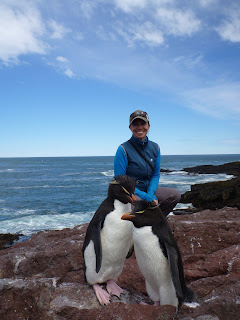
Rock hopper penguins
Eventually, of course, we had to bid farewell to the penguins and sea lions and skuas and head back to town.  For the perfect ending to the perfect day, Carl and I visited the restaurant Puerto Cristal for an amazing sea food smorgasbord.  Some lucky guessing and menu roulette netted us some pan fried calamari to start, then a plate of clams smothered in a creamy sauce for Carl and a bowl full of rice topped with a tomato-based stew of clams, mussels, shrimp, and fish for me.  We were in such culinary heaven we didn't even need dessert.

The next morning we had to rise at 2:00 in order to make the hour trek to the bus stop for our 4:00 AM bus.  There were a surprising number of people out at that hour, mostly young teenagers with nothing better to do. From there we slept most of the way back to Los Antiguos, making our connection this time, and crossing the border without incident.  One more night in Chile Chico, then the 8:00 AM ferry across Lago General Carrera.  The wind nearly blew us off the deck but we did get to see the whole mountain range.  Cerro Castillo was out to welcome us back.
The Cerro Castillo range from Lago General Carrera

Bumps in the Road, Part I

Travel is not a glamorous activity.  If you have enough money, of course it can be, but for the rest of us it tends to be an arduous undertaking of patience and perseverance interspersed with moments of sheer glory.   The travel magazines don't talk about the endless hours of waiting in airports, at bus stops, and on the side of the road.  They don't tell you about long bus rides through boring countryside and ugly concrete cities, or endless trudges across depressing towns in search of a decent place to sleep.  The articles don't include the frustrations of missing a bus because the connecting city got lost in the language barrier, or finding that the only ATM for 300 miles doesn't accept your card, or feeling like the entire universe is conspiring to keep you from your goal.  They say it's all about the journey, but sometimes the journey's really not that fun.

Such was our misadventure down Chile and into Argentina.  Mary, Cristian, Benjamin, Carl, and I were all loaded into their car and driving south on the gravel Carretera Austral to go rafting with their friends when the car started shaking alarmingly only five minutes into the trip.  Cristian wisely decided to turn around (it turned out the power steering was being held in place by one out of four screws, and even that one was loose), and we arrived back at Cerro Castillo just in time for Carl and me to catch the last south-going bus.  Needless to say, for the rest of the journey we were on our own.

We successfully found the tiny hamlet of Bertrand, where we spent the night in a lodge perched on the edge of the lake, and woke the next morning to go rafting down the beautiful blue waters of the Rio Baker.  Safely back on shore, we headed to the bus stop to await another bus, only to be pleasantly surprised when our hopeful thumbs garnered us a comfortable ride south in a new VW truck.  The driver was an pleasant fellow who worked for a water company here in Patagonia, and we had an interesting discussion about Douglas Thompkins, the founder of North Face, and his private reserves as we passed one by.
Confluence of the rivers Baker and Neff
Thompkins is seen as something of a hero of conservation in the States, especially if you've seen the movie "180 Degrees South", but you start talking to folks down here and a much different side comes to light.  While he's done a good job recruiting international attention for the Patagonia Sin Represas movement (Patagonia Without Dams), his attitude towards the local people is condescending and disrespectful of their culture and customs, putting his park's well being before anything else.  The conservation he's done is accessible to selective foreigners only and any research done or artifacts found go back to the States, leaving little benefit for the general population of the area.  It's a complicated topic about which people hold very strong opinions.

Our conversation concluded when we arrived in Cochrane, the last decent sized Chilean town on our way south.  We had been counting on the ATM there to replenish our cash supplies, but to our dismay it only accepted Mastercard.  With my limited Spanish we couldn't figure out if this was a temporary problem or a permanent situation, so we were forced to spend the night and rethink our plans.  Next day we headed to the bus stop to try our luck hitchhiking back north, aiming for Chile Chico on the Argentine border.  We got picked up within the half hour by a pickup and loaded into the back, only to stop 500 feet later to pick up another couple with their bags.  Four people and four large backpacks in a 3' by 3' truck bed on a dusty gravel road is not comfortable.  We were incredibly relieved to hop out at the intersection with the eastward road about an hour later.
Eating dust on the Carretera Austral
Next stage of the journey was a hot, dusty, discouraging 5 mile hike up the road towards Puerto Guadal.  We finally got a ride for the last mile and spent the night there on the shores of Lago General Carrera.  Next day we had no luck hitchhiking and caught the evening minbus to Chile Chico, only to find that the ATM there was a twin of the one in Cochrane.  Morale was extremely low, to say the least.  We spent another night in a crowded campground and decided that in the morning we would make a break for Argentina.  If the ATMs there worked, we'd continue on into that new country; if not, it was back to Cerro Castillo with our tails between our legs.

To be continued...